
6 mins
Content
UK: Inflation eased and growth strengthened, but markets lagged
Europe: Rising inflation and weaker growth weighed on sentiment
US: Strong market returns were supported by economic resilience
Asia: Markets delivered strong returns while inflation remained low
Looking ahead
At a glance
From easing inflation in the UK to continued strength in US and Asian markets, May provided further evidence that economic conditions can vary significantly across regions.
While headlines continue to focus on inflation, interest rates and geopolitical tensions, the broader picture remains one of resilient global growth and positive market performance.
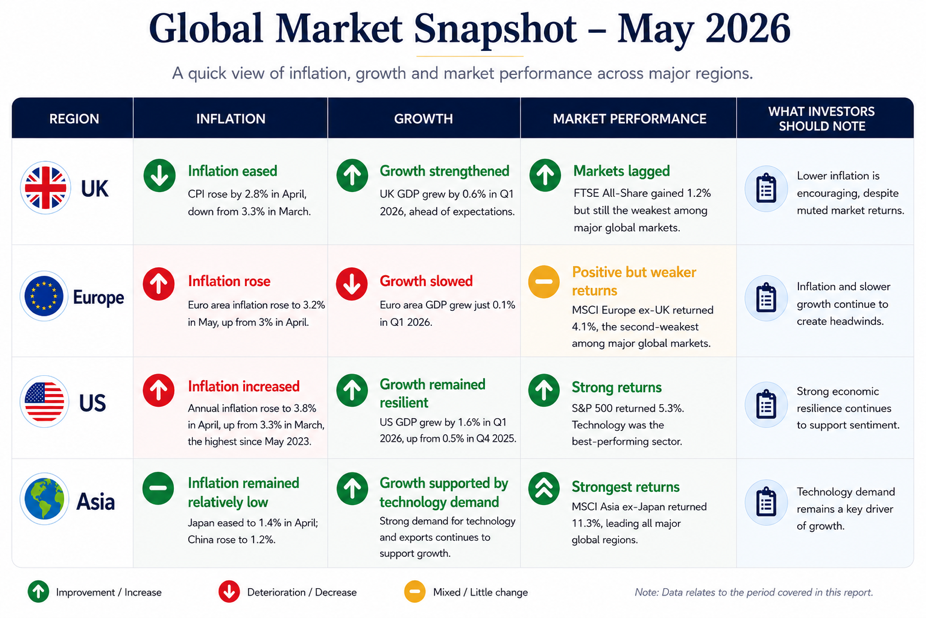
Overview
Inflation rose in several regions, but notably not in the UK, where it fell below expectations. Economic growth remained positive across the board, although it slowed in some areas as businesses and consumers continued to navigate higher prices and ongoing political tensions.
While market performance varied across regions, the broader picture remains one of resilience. The UK economy showed encouraging signs of strength, US markets continued to perform well, and Asian markets were among the strongest performers globally. While economic and political developments will continue to influence financial markets, the most important influences on investment performance often play out over years rather than days.
UK: Inflation eased and growth strengthened, but markets lagged
In the UK, inflation eased and economic growth was stronger than expected, although financial market returns remained relatively muted.
The latest data from April showed inflation rising by 2.8%, down from 3.3% in March. Housing and household services made the largest downward contribution, while fuel prices rose considerably1.
At its most recent Monetary Policy Committee meeting at the end of April, the Bank of England held the base rate at 3.75%, citing March’s rise in inflation and the ongoing conflict in the Middle East as factors that could keep inflation elevated. However, inflation has since eased more quickly than expected, raising questions about how the Bank may respond at its next meeting in the coming weeks2.
Meanwhile, the UK economy grew by 0.6% in the first quarter of 2026, ahead of expectations. As a result, forecasts for economic growth this year have been revised upwards from 0.8% to 1%3.
For investors, lower inflation and stronger economic growth are generally encouraging signs. Lower inflation can ease pressure on household finances and increase the likelihood of future interest rate cuts, while stronger economic growth can support company earnings and business confidence.
Taken together, lower inflation and stronger economic growth are generally encouraging signs for investors. However, UK markets did not fully reflect this improving backdrop. The FTSE All-Share Index, which tracks around 900 of the UK’s largest listed companies, returned 1.2% in May, although it lagged behind broader European and global equity markets due to the UK’s relative lack of technology exposure, making it the weakest performer among the major global markets4.
Europe: Rising inflation and weaker growth weighed on sentiment
Europe faced another challenging month, with inflation rising and economic growth slowing across much of the region.
Euro area inflation increased to 3.2% in May, up from 3% in April and its highest level since September 2023. Among the region’s major economies, inflation rose in Spain, the Netherlands, Italy, and France, while Germany recorded a slight easing5. This uneven picture comes at a time when economic growth across the region is already slowing, creating a more challenging backdrop for policymakers and investors alike.
At the same time, economic growth remained subdued. The Eurozone economy shrank by 0.2% in the first quarter of 2026, revised down from an initially reported 0.1% growth. This marks the first contraction since Q4 2022 and the sharpest decline since mid-2020, driven by a significant downward revision to Ireland’s GDP. Several of Europe’s largest economies have also lowered their growth forecasts for the year ahead6.
For investors, rising inflation combined with slower economic growth can create a more challenging backdrop. Higher inflation can increase the likelihood of interest rates remaining elevated, while weaker growth can weigh on company earnings and investor confidence.
Despite these headwinds, European equities still delivered positive returns in May. The MSCI Europe ex-UK Index, which tracks large- and mid-cap companies across the region, returned 4.1% over the month. However, it remained the second-weakest performer among major global markets7.
US: Strong market returns were supported by economic resilience
The US economy remained resilient during May, supporting strong market performance despite ongoing inflationary pressures.
The annual inflation rate rose to 3.8% in April 2026, up from 3.3% in March and marking its highest level since May 2023. Higher energy costs, driven by the ongoing conflict in the Middle East, were a key factor behind the increase8.
Meanwhile, the US economy grew by 1.6% in the first quarter of 2026, up from 0.5% in the final quarter of 2025, although the final figure was lower than the earlier estimate of 2%9.
For investors, the resilience of the US economy remains an important source of market confidence. While higher inflation has increased uncertainty around the timing of future interest rate cuts, strong economic growth and healthy corporate earnings have continued to support investor sentiment. Investors have also taken comfort from the ability of many US businesses to continue growing despite a more challenging economic backdrop.
US markets had a solid month, and the S&P 500 returned 5.3%. Technology was the best-performing sector, and Nvidia was once again a standout, though its competitors performed less well as confidence in AI continues to cool10.
Asia: Markets delivered strong returns while inflation remained low
Asian and emerging markets were among the strongest performers in May, continuing a trend that has seen them outperform many global peers this year.
The MSCI Asia ex-Japan Index, which measures the performance of large- and mid-cap companies across Asian markets excluding Japan, returned 11.3% in May, making it the best-performing major regional index. The MSCI Emerging Markets Index also delivered strong returns, rising 9.7% over the month11.
Across the region, inflation remained relatively subdued. In Japan, inflation eased slightly to 1.4% in April, down from 1.5% in March12, while the TOPIX Index, which tracks a range of Japanese companies, gained 6.2%13. Meanwhile, in China, inflation rose to 1.2% in April from 1% the previous month, exceeding expectations of 0.8%14, but remaining low by international standards.
For investors, lower inflation can provide a more supportive backdrop for economic growth and financial markets. Combined with Asia’s important role in global technology manufacturing and supply chains, this has helped support confidence in the region and contributed to strong market performance.
Asian markets remain an important part of the global economy, particularly as demand for technology and AI continues to influence investment trends around the world.
Looking ahead
Ongoing geopolitical events may continue to create periods of market volatility and uncertainty in the months ahead.
However, market movements are only one part of the picture. while wider economic trends, such as inflation, may also be affected, history shows that markets have tended to recover from periods like this and grow over the longer term. So, it can be helpful to focus on your longer-term plans rather than short-term market movements.
If you have any questions about your portfolio or would like to discuss your plans, your adviser will be happy to help.
1 22.04.26 Consumer price inflation, UK: April 2026 ONS, 2 30.04.26 Interest rates and Bank Rate: our latest decision Bank of England, 3 18.05.26 UK growth forecast upgraded by IMF but risks remain BBC, 4 01.06.26 Review of Markets over May JP Morgan, 5 02.06.26 Euro Area Inflation Rate Trading Economics, 6 02.06.26 Euro Area GDP Growth Rate Trading Economics, 7 01.06.26 Review of Markets over 2025 JP Morgan, 8 01.06.26 United States Inflation Rate Trading Economics, 9 02.06.26 United States GDP Growth Rate Trading Economics, 10 01.06.26 Review of Markets over 2025 JP Morgan, 11 01.06.26 Review of Markets over 2025 JP Morgan, 12 01.06.26 Review of Markets over 2025 JP Morgan, 13 02.06.26 Japan Inflation Rate Trading Economics, 14 02.06.26 China Inflation Rate Trading Economics
___
The value of your investment(s) and the income derived from it, can go down as well as up and you may not get back the full amount you invested.
This article is for general information only and does not constitute advice. The information is aimed at retail clients only. The content of this article was accurate at the time of writing. While information is considered to be true and correct at the date of publication, changes in circumstances, regulation, and legislation after the time of publication may affect the accuracy of the article.
Succession Wealth Management Ltd is authorised and regulated by the Financial Conduct Authority. Financial Services Register number 588378. Succession Wealth Management Limited is registered in England and Wales at The Apex, Brest Road, Derriford Business Park, Derriford, Plymouth PL6 5FL
EX2026-005 - last updated June 2026